Blog

  • Scottish Rural and Islands Parliament

    Scottish Rural and Islands Parliament

    We worked with Scottish Rural Action to refresh their logo and build the first dedicated website for the Scottish Rural and Islands Parliament.

    ‘We were delighted to work with Isle Develop on a new website for the Scottish Rural and Islands Parliament. Isle Develop took time to understand our needs and gave us very helpful suggestions as and when.

    They have lots of creativity and supplied us not only with a fantastic website, with a brilliant logo too.  Working with Kyle, Rou, Rhoda and Mark was not only an easy process, but they are fun, understanding, professional and insightful. We are very pleased!’

    Catriona Mallows – Scottish Rural Action

    We have recently updated the website to reflect the fact that the Parliament is over. We will keep working with the SRA to make sure that videos and notes from the event are add to the site.

  • Young Islanders Network

    Young Islanders Network

    We worked with the Young Islanders Network to develop a brand new website.

    They wanted a hub to showcase their projects and news, as well as an interactive map of their locations.

    The project went through two phases. We built the first version of the site and provided an animation challenge and a mapping challenge, so that young people could be part of the second phase of design.

    We incorporated their ideas into the second version of the site.

    Rhoda and Mark worked with Jack Lockhart from Screen Argyll for the animation components of the project.

    The Young Islanders Network project was commissioned by Youth Scotland.

  • Digital Trainee Posts

    Digital Trainee Posts

    CLOSING DATE: Friday 17th March

    Do you want to learn how to design, develop, and maintain websites?

    Isle Develop CIC has 2 Digital Trainee posts available. Applicants should be based in Tiree. Find out more about Isle Develop here.

    You would work with us part-time for a minimum of 6 months, learning on some of our existing websites, completing training, and helping us build new sites for clients.

    Some of the things you might do would include

    • Updating content on existing websites
    • Helping plan and design new websites
    • Learning basic coding
    • Learning how systems like Woocommerce and WordPress work so that you can help manage client websites
    • Sitting in on client meetings
    • Learning the principles behind troubleshooting and debugging
    • Learning to use a variety of other digital tools, such as Google Analytics, Stripe Payment Processing, Canva and other apps.

    Skills required

    • Willingness to learn
    • An interest in IT and the digital space
    • A proactive approach to work and able to show initiative
    • Ability to work with others

    Accountability: The post is accountable to the Directors of Isle Develop CIC who are the employers. This post is managed by Rhoda Meek, the Managing Director of Isle Develop.

    Hours: 16 hours per week. This is a fixed term 6 month contract.

    Salary: £20,000 Full Time Equivalent. You will be employed on PAYE.

    • We follow the Scottish Living Wage guidelines. You can expect to earn circa £10.98 an hour before tax.

    Location: Tiree. 1.5 Days in the office in Crossapol. The remaining time working from home.

    Pension: A pension contribution equating to 3% will be paid.

    Holidays: FTE 28 days paid holiday per leave year (inclusive of UK/Scottish Bank holidays) which would equal 6.5 days over the length of the six month contract.

    Equipment: A laptop will be provided.

    To apply: Please email rhoda@isledevelop.com with a CV and a covering letter telling us why you want the job!

    The closing date for applications is Midday on Friday the 17th of March.

    These posts are funded by Firstport.

  • What Isle Develop did next.

    We’re taking on Airbnb. Because, if you can’t beat them — join them.

    When I started isle20.com, a business directory for the Scottish islands — way back at the start of Covid — it was a wee idea that felt like it might be useful for a few folk.

    Photo by Gary Ellis on Unsplash

    It became a marketplace, offering an ecommerce facility for businesses. Then I realised that this was an opportunity to create a permanent shopping platform which might help islanders sell more in the off-season.

    I decided it should be one of multiple projects under a social enterprise. So I formed Isle Develop CIC and started experimenting with new ideas.

    Then I started talking to people about the project and trying to figure out how we could make an impact — both with digital projects AND with the profits.

    People kept talking about the islands’ housing crisis. And I kept putting my head in the sand.

    It wasn’t that I didn’t understand the housing issue, it was that it felt so big and so impossible.

    One day, I saw that a property with huge potential, which had been on the market for ages had dropped its price, and I wondered to myself whether I could buy it, put it on a long term let and develop the associated buildings.

    So I did the maths and the research, and I discovered that despite being in good full time employment with a software company, and theoretically able to get the mortgage (although I was unclear about where I would find the deposit!) I would be unable to make the mortgage repayments without subsidising it myself, unless it was set up as a short term holiday let.

    And that’s when something inside me snapped. Again. (It’s the second snap in a few years.)

    The system is broken. Property in the islands is too often seen as no more than a business opportunity. It’s bought up and renovated by people who don’t stay here, and then put on short term lets. And then we are told that we should be campaigning for affordable housing. And now we have to, because in many places, buying properties which currently exist is a pipe dream.

    Because of a lack of understanding, a lack of regulation, and a systemic failure at all levels of government to understand island economies, we’re faced with a problem not of our making. And it is literally destroying our communities.

    In my village 50% of the properties stand empty in the off season. 50%.

    Everyone who owns them is lovely. Individuals all mean well and have good reasons for owning property but collectively, communities are sinking under weight of empty houses, second homes and holiday lets.

    And so, having joked about doing a version of isle20.com, but for holiday lets… It became less of a joke. Friends were willing to advise and help, the Isle Develop board were willing to take a risk on it, Firstport gave us some funding, and a year’s worth of work later…

    We’re taking on Airbnb. Because, if you can’t beat them — join them.

    This is isleHoliday.com. A holiday lettings website for the Scottish islands. We will reinvest the commission we take into our communities, into creating jobs, and into supporting small businesses AND housing projects.

    Why? Well, we can’t change the law overnight and we can’t force people to sell.

    We understand that the current market means that long term letting is not a viable alternative for people who have sunk a lot of money into property and want the freedom to visit it.

    We understand that second homes and letting properties exist for a variety of reasons, not least for island residents to subsidise income, or to keep a grip of a fast disappearing heritage.

    And we don’t want to lose tourism — we live in beautiful places, which we want to share. More businesses than I can count rely on it in so many ways. It is vital.

    But tourism needs to work better. Being a “destination” needs to work for the benefit of island communities. Without the communities, there is no destination.

    And so the short term letting model exists. And will continue to exist. It is rife with complexity — both logistical and emotional — but there is a way to ensure that more of the benefit stays in the islands.

    There is a commission model built into the system. Most of the current booking platforms are for profit. The big guys are not based in Scotland. Some are not even based in the UK. The commission they take for advertising property goes into their business.

    Let’s keep that commission. By working across islands, listing properties and taking bookings, we can do exactly that. More than that, we can tell our story to people who book through us. We can tell visitors what we want them to know — about our awesome communities, and our history and languages and culture, and even about the mobile signal and the passing places.

    We want to put faces to places and start to change the narrative from destination first, to community first.

    Visitors will have a better experience if we correctly set their expectations. Our islands are not empty wildernesses waiting to be discovered. They are full of beauty AND they contain people. They are full of heritage and history, and of present and, we hope, future. Those are gems well worth discovering.

    If you own a letting property in the islands, please consider listing on isleHoliday.com. You don’t have to leave other platforms — this is simply an additional option. If you are booked up for 2022, we don’t don’t mind — 2023 isn’t far away!

    If you holiday in the islands, please consider booking through isleHoliday.com.

    If you can’t find something suitable (we’re just getting started) then please tell people about us. Or do your shopping on isle20.com and sign up to the newsletter.

    Or just share this and help us start to turn the tide.

    If you’re a property owner and still wondering… When you sign up to be listed on isleHoliday, you get:

    • One-to-one support via email, phone or video call. We know it’s daunting setting up something new, but we’re here to help.
    • A passionate team who love to talk all things island — we know our Bernerays from our Benbeculas!
    • Full control of your pricing; unlike Airbnb, our commission is fixed and upfront. No hidden costs, and no price hikes for your guests.
    • SUPERHOG damage insurance
    • A FREE window sticker to show everyone that you are part of the solution.
    • An optional web page and domain name, just for you.
    • A Visit Scotland listing if you don’t already have one.
    • A great guest experience with our tailored and informative island emails.
    • Our knowledgeable team will offer support as the licensing laws change in Oct 2022
    • Peace of mind knowing that the commission we take will be used to make the islands we all love more sustainable and resilient.

    Register for more information here

  • How you are helping

    As a Community Interest Company, Isle Develop CIC is committed to putting all surplus back into island communities.

    To do that, we have created the Isle Develop Fund. The fund will:

    • Provide small grants to micro businesses (1-2 people) to purchase pieces of equipment which will help them become more sustainable year round.
    • Offer grants to local groups to support housing surveys, projects and campaigns relating to long term affordable island accommodation.

    Tiree Crab Company

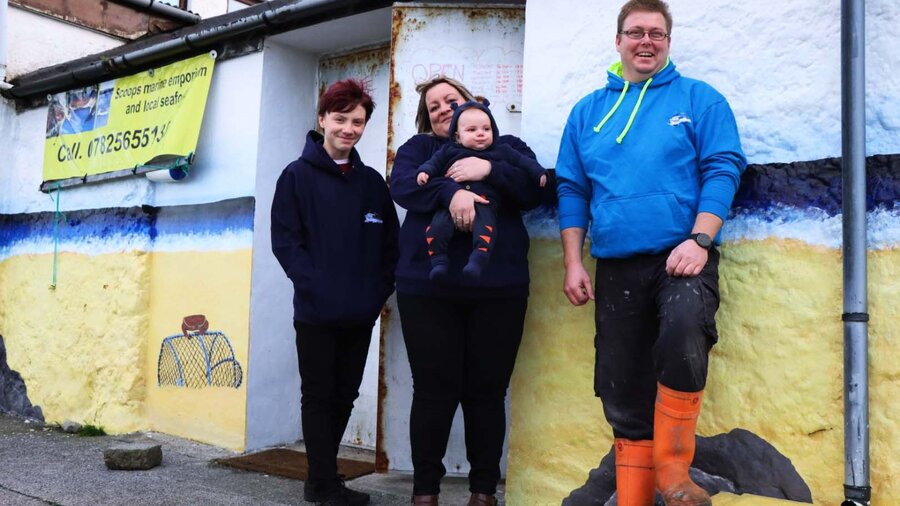
    Meet Kirsty and Callum – starting a new seafood venture in Tiree!

    scoop

    Callum Williams and Kirsty Bennett from the Isle of Tiree took a huge step this year, opening a new retail outlet in Tiree for locally landed and sourced shellfish.

    “It’s great to have support from another local business to help us grow and provide a year round service whilst working closely with other island producers.”

    Callum Williams

    As well as selling shellfish they catch from their own boat, they have already expanded to sell a variety of great food products from across Argyll.

    Isle Develop CIC was delighted to award them one of our first grants towards the purchase of freezer equipment which would allow them to freeze stock – extending their season and making their business more sustainable year round.

  • I’m building a thing… One year on.

    That was the tweet that started one of the crazier years of my life.

    If you’re reading this, you probably know about isle20. About the teabags and the business directory and the ecommerce platform which became a social enterprise and spawned a whole new set of challenges. (If not, start here)

    I have worked harder than I knew I could to make this thing work. I have nearly totally lost the plot on a couple of occasions and had to be talked down before I sent an email I would regret. I might also have sent some emails I regret…

    I have hunted seals in the postal system, explained the workings of the Colonsay ferry more than once, and developed a twitch in both eyes. I’ve written countless social media posts and nurtured an all consuming hatred of facebook advertising settings. I’ve apologised and refunded and humoured. I’ve broken the site more than once. And a keyboard. Possibly a mouse.

    I’ve been in tears – mainly of frustration and exhaustion. I’ve over-reacted and under-reacted. I’ve been terrified of what I have created and what could go wrong, and how the heck do you do the paperwork and why does nobody tell you how employing someone works in practice… and if your annual gross pro rata puffin is more than the enhanced analytics point of sale sequence divided by two sgadain can anyone but the cats hear you scream?

    Honestly though? I have loved it. There is plenty I would change about this past year, but creating isle20 and then Isle Develop CIC is not one of them.

    I got to catch a wee wave and have a hockey stick graph – both of which in startup terms are Good Things™ – so as a tech geek, I can die happy.

    And I am genuinely fascinated to see where we are in a year’s time. I’m never entirely sure what the next thing is. Whilst I’ve usually got an idea, or an experiment or part of a plan brewing, the what is always up for discussion.

    The why is not.

    Why did I create isle20 and then Isle Develop CIC? Why will I keep trying things until I find the right projects to help us support small businesses or community led projects in a meaningful way?

    Because people are what makes a place. People are what make our island communities. People are the rocks, the roots, the history – past, present and future. They are the business owners, the bus drivers, the volunteers. They are the parents, the teachers, the nurses, the doctors. They are the crofters, the fisherfolk, the care workers, and the posties – even us IT folks! In 2020 our island communities pulled together and made incredible things happen – from massive online raffles to fundraise for hospices, to creating networks of volunteers who are still doing shopping and collecting prescriptions for vulnerable folks a year later.

    As islanders, we live in remarkable places. But our island homes are more than a photo opportunity. We can’t eat the view and contrary to popular belief, time doesn’t stand still. We’re facing climate change, depopulation, a housing crisis, economic uncertainly, and the loss of indigenous dialects, language and culture.

    The goal is not just for our communities to survive, but to thrive – all year round.

    That’s the why.

    The what next? We’ll see!

    – Rhoda

  • The origin story

    The origin story

    Isle Develop CIC began because of isle20.com. isle20 started as a message to a few friends in early March 2020 (Covid times v1), where I joked that I might put together a directory website of island businesses and call it isle20. That way, people could come and do their shopping in the islands even if they couldn’t make it over on holiday this year.

    I was mainly tickled by the pun. I do like a good pun.

    On a serious note though, I and many others, were becoming increasingly aware that tourism in the Scottish islands was going to be badly hit in the wake of Covid-19.

    It was particularly acute for me at that time as I sat with a few thousand pounds worth of tea in my spare room. I had just taken my first proper steps into creating a wee tea label – Tiree Tea – with the intention of selling tea over the summer months. It was further compounded by the fact that just before the pandemic reared its head, I had decided to walk away from my main contract (as a Product Manager in software development) and take a few months break – selling tea and picking up work here and there.

    My timing has never been good.

    So yeah, a lot of tea, no work, no tourists… And then I got thinking. Back in the late 90s (gasp) when I was discovering the internet and starting to build pages, there was a world of directory sites. This was pre-google. I’m old.

    Not only were there lots of niche directory sites, but there were site rings, where one site had a link at the bottom to send you off to the next site in that niche. Interest groups helped each other by collaborating and sending traffic to each other.

    So I dusted off my web hosting and got going. 8 hours later, I sent a tweet out on my personal account asking for wee island businesses to try signing up for a free listing – after all, if I was going to create a directory I needed some listings that were’t just my tea. And from a Product Management perspective, I needed to see what the uptake was – even at that early stage. If no-one was interested, then further work would be a waste of time.

    For once, my timing was spot on. Businesses started signing up, the tweet got shared, and word of mouth got on the move. Six or seven weeks later there were almost 360 island businesses listed on isle20. Once the listings started increasing, I turned my attention to driving traffic to them. I threw caution to the wind, created a logo and spun up some social media accounts. It might as well look real, I reasoned.

    Then I got some lucky breaks – it was shared by the Peter and Jane Facebook page – which has a HUGE following, it was picked up by BBC Alba, and even managed to feature on the Guardian live blog. Slowly but surely it gathered momentum. A huge part of the success has been the social media sharing, where the businesss who are signed up share isle20 posts, regardless of whether they themselves are mentioned – which in turn drives traffic to everyone. Old school solutions for new problems.

    In creating isle20, and increasing digital footfall to island businesses, I had found another problem, and created yet another.

    The problem I had uncovered was that a large percentage of the businesses who had signed up only had a facebook page to direct people to. These are often wee businesses making beautiful, high quality products, but relying on local retailers or passing traffic. And whilst there are plenty of ecommerce solutions out there, even the supposed simplest ones can be daunting, and expensive.

    As the Covid crisis gathered steam, people had approached me about building them websites – which I can do – but the risk was the upfront cost, coupled with on-going maintenance. The second problem was the one I had created (I’m good at creating problems). I had created a full time job for myself. A marketplace seemed like the obvious solution to both those problems. So I built one on a commisison based model and started advertising it. It has shown great potential to help folk sell beyond the crisis – hopefully extending the sales season.

    And that’s where I started thinking that what I really wanted to do was keep experimenting.

    If you’re on twitter at all, you might have come across my ramblings. Lots of them relate to islands, to culture, to the importance of seeing islands as communities first and destinations second, and to the need to build resilience that takes us beyond reliance on tourism. (tl;dr Tourism is good when well managed to the benefit of residents, but it should not be the raison d’etre of a place. Our islands are more than the sum of our campervans.)

    We are islands full of incredible talent and skills not to mention a propensity for hard graft in multiple roles, and a capacity to cope with crises. The traditional island way is to problem solve, to make do and mend, to reuse and recycle and to find new and more efficient ways to complete tasks. Historically, when you were a small community in the middle of the sea, at the mercy of the weather and nature, you were forced to innovate – and to work together. Crops failed, animals died, boats sank – and you had to carry on. All of these things remained true despite having internet and it being 2020.

    For me, Covid19 crystalised my thinking. It brought into sharp relief the risks of increasing reliance on tourism. In fact, tourism is only one of the pillars that hold our communities up. We need to remember that. There are many successful businesses in our islands which trade beyond island shores. Our islands have long bred explorers and seafarers who have traveled the world, bringing back new ideas and notions. There are two ostrich eggs in this house that remind me of that every time I open the cupboard and wonder what on earth to do with the wretched things that my Great Uncle brought back proudly from a jaunt to Africa. He also brought a monkey, but that’s another story.

    What Isle Develop did next

    I decided isle20 should be one of multiple projects under a social enterprise. So I formed Isle Develop CIC and started experimenting with new ideas.

    Then I started talking to people about the project and trying to figure out how we could make an impact — both with digital projects AND with the profits.

    People kept talking about the islands’ housing crisis. And I kept putting my head in the sand.

    It wasn’t that I didn’t understand the housing issue, it was that it felt so big and so impossible.

    One day, I saw that a property with huge potential, which had been on the market for ages had dropped its price, and I wondered to myself whether I could buy it, put it on a long term let and develop the associated buildings.

    So I did the maths and the research, and I discovered that despite being in good full time employment with a software company, and theoretically able to get the mortgage (although I was unclear about where I would find the deposit!) I would be unable to make the mortgage repayments without subsidising it myself, unless it was set up as a short term holiday let.

    And that’s when something inside me snapped. Again. (It’s the second snap in a few years.)

    The system is broken. Property in the islands is too often seen as no more than a business opportunity. It’s bought up and renovated by people who don’t stay here, and then put on short term lets. And then we are told that we should be campaigning for affordable housing. And now we have to, because in many places, buying properties which currently exist is a pipe dream.

    Because of a lack of understanding, a lack of regulation, and a systemic failure at all levels of government to understand island economies, we’re faced with a problem not of our making. And it is literally destroying our communities.

    In my village 50% of the properties stand empty in the off season. 50%.

    Everyone who owns them is lovely. Individuals all mean well and have good reasons for owning property but collectively, communities are sinking under weight of empty houses, second homes and holiday lets.

    And so, having joked about doing a version of isle20.com, but for holiday lets… It became less of a joke. Friends were willing to advise and help, the Isle Develop board were willing to take a risk on it, Firstport gave us some funding, and a year’s worth of work later…

    We launched isleholiday.com. It’s like Airbnb, but the commission goes to the islands, not to San Franciso. Because, if you can’t beat them — join them.

    I know I’m not alone in having ideas about how we can grow our island economies – and so I don’t just want to develop my own ideas, I want to figure out how I can help other people to grow and test their ideas too.

    Where we are now

    And that’s where we are now. As a fully fledged digital agency Isle Develop builds simple, easy to use websites for small businesses, charities and community groups based anywhere.

    Our larger commercial projects support the smaller ones, and our inhouse projects – isle20 and isleholiday, continue to run to the benefit of our island communities.

    If you need an innovative approach to solving a digital problem, we’d love to hear from you!

    If you want to find out more about me generally, I’m here – rhodameek.co.uk